Some pictures featured in this article may be upsetting to some viewers.
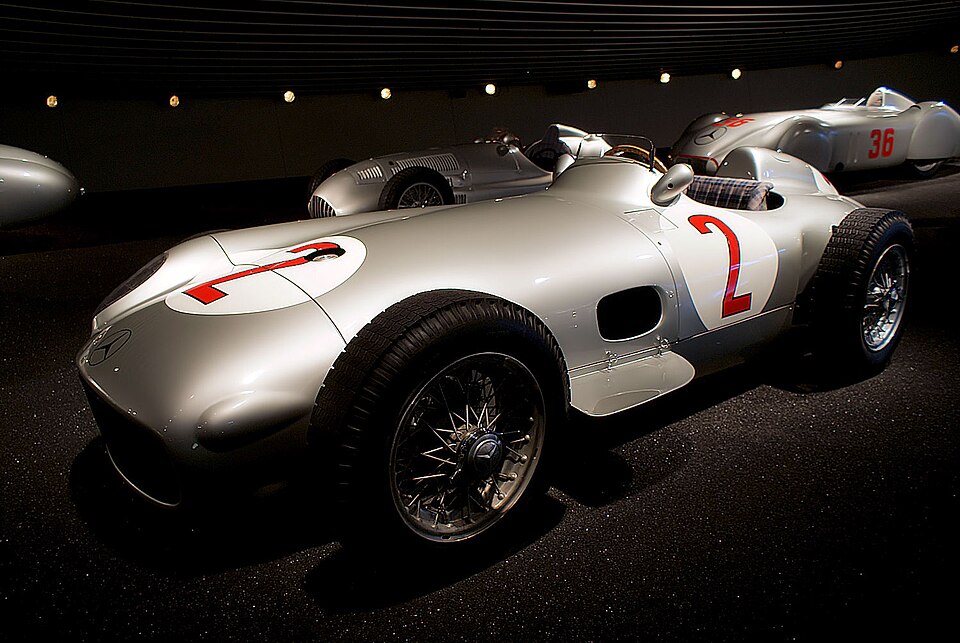
In 1954, Mercedes-Benz entered Formula 1 for the first time as a factory constructor team. Bringing with them, the W196, they dominated the circuits. That year, the Mercedes team won 9 out of 12 races, securing Juan Manuel Fangio his first world title. Stirling Moss would later join the team in 1955.
The 1955 season was off to a good start as Fangio took the first win of the season at the Argentine Grand Prix. The next race, held at Monaco saw both of the Mercedes drivers plagued with mechanical issues that forced a double retirement. The following race, held at The Indianapolis 500 was included in the Formula One championship, but no F1 drivers attended. In the fourth round of the 1955 season, Mercedes showed excellent performance pace, with Fangio leading Moss to a dominant 1–2 finish. After this race, Fangio was leading the championship, 7.67 points ahead of Ferrari’s Maurice Trintignant.
On 11 June, the 24 Hours of Le Mans took place and many F1 drivers participated in the spectacle. There was a lot of anticipation for the 1955 endurance race, as Ferrari, Jaguar, and Mercedes-Benz had all won the race previously, and they had all brought improved cars. The Mercedes team manager paired his drivers, putting his two best drivers, Juan Manuel Fangio and Stirling Moss, in the lead car, while Karl Kling paired with André Simon, John Fitch with Pierre Levegh.
As the race began at 4 pm, the cars of Eugenio Castellotti, Hawthorn, and Fangio were leading field in the first hour, representing the three top teams of Ferrari, Jaguar and Mercedes. The other team cars were driving more conservatively, while still competing in the top ten. Going into the second hour, Castellotti started to loose pace, but Hawthorn and Fangio continued the duel, swapping the lead, while lapping most of the field. At the end of lap 35, the leading cars began their pit stops.
On lap 34, Hawthorn’s pit crew had signalled for him to come in the next lap. He had just lapped Levegh in 6th place, and was pushing to keep Fangio at bay for as long as he could. He rapidly caught up to Lance Macklin, who had seen him and moved over to the right to let him pass. Putting another lap on Macklin coming up to the main straight, Hawthorn then raised his hand to indicate he was pitting and pulled across to the right, and using the Jaguar’s advanced disc brakes, braked hard enough to rapidly slow his Jaguar from his racing speed.
Also breaking hard, Macklin ran off the right-hand edge of the track, throwing up dust. Macklin then swerved left to avoid Hawthorn, who was slowing down. As a result, Macklin’s car veered across to the centre of the track, briefly out of control. This put him into the way of Levegh’s Mercedes, closing in at over 120 mph. Levegh had no time to evade and, as he was about to collide, raised his hand to warn Fangio, who squeezed through the chaos, pushing Hawthorn’s stationary Jaguar in the pits, allowing him to pass. Levegh’s front-right wheel rode up the rear of Macklin’s car, launching Levegh’s car into the air, flying over spectators and rolling end over end for 260 ft. The cars had no seat belts, because the drivers thought that it was better to be thrown clear in a collision rather than be crushed or trapped in a burning car. Unfortunately, this reasoning was flawed, and Levegh was thrown out of his tumbling car, hitting the ground, and crushing his skull upon impact, which killed him instantly.
Embed from Getty ImagesThe scene of the crash at Le Mans racing circuit, after Pierre Levegh’s Mercedes-Benz spun out of control and exploded into the tightly packed crowd, killing Levegh and 80 spectators and injuring many more.
The car landed on the embankment between the spectators and the track, bounced, then slammed into a concrete structure, destroying the vehicle. The heaviest pieces of the car flew into the crowd for almost 330 ft, crushing all in their path. The car’s hood sliced through the air, decapitating the jammed audience. Shrapnel was soaring through the air, flying towards tightly packed grandstands.
When the rest of Levegh’s car landed on the mound, the rear-mounted fuel tank exploded, raising the temperature of the remaining bodywork past its ignition temperature. The alloy burst into white-hot flames, showering the track and crowd with magnesium embers, which greatly intensified the flames. The car burned for several hours.
Embed from Getty ImagesThe gutted wreckage of the Mercedes driven by Pierre Levegh burns on the shoulder of the Le Mans 24-hour track after hurtling through crowd of spectators
Meanwhile, Macklin’s heavily damaged car, crashed into the barrier, veered to the right of the track into the pit lane, narrowly missing three other cars, all of which were already in the pits refuelling before the accident. Macklin’s car hit the unprotected pit-wall, crushing a policeman, a photographer and two officials, all of whom were seriously injured, before rebounding back across the track again and hitting the fence for a second time.
The disaster resulted in 84 fatalities, including Levegh and 83 spectators, making it the deadliest accident in motorsport history. The tragedy created large shock waves in the motorsport world. The crash caused multiple European countries to immediately ban motorsport, forcing the cancellation of the French, German, Swiss, and Spanish Formula 1 Grands Prix that year. This reshaped the 1955 calendar, wiped out nearly half the schedule, leaving just 7 races by the time the season concluded. The fallout permanently erased certain historic tracks from the F1 map. Following the crash, Switzerland passed a strict national ban on all circuit motorsport that lasted up until July of 2026. As a result, the historic Bremgarten circuit was abandoned and F1 never returned to Swiss soil. Spain’s Pedralbes street circuit suffered a similar fate, as new safety standards deemed it entirely unviable for future racing. At LeMans, the entire pit lane area was rebuilt further back, to widen the track and separate the spectators from the action.
Because four major rounds were stripped from the calendar, the remaining points available shrank drastically. Following the British Grand Prix, it became mathematically impossible for anyone to catch up to Juan Manuel Fangio. The cancellations effectively secured the Drivers’ Championship early, handing Fangio his third world title with minimal late-season pressure.
The shadow of Le Mans prompted Mercedes-Benz to completely pull out of Formula 1 and all factory motorsport at the conclusion of the 1955 season, despite having the most dominant car on the grid, and the sport’s top two drivers. The German team did not return to F1 as a full constructor for another 55 years. This had led a lot of fans to question what Mercedes would look like now.
Given their histori dominance when they compete as constructors, it is almost certain that if Mercedes had continued to compete for those 55 years, they would have been the most successful F1 team of all time. Highly successful teams also draw in more fans, thus, it is likely that Mercedes could have built a Ferrari-level fanbase by now.
Mercedes have historically been a competitive team, but a disastrous race, and a lot of tragic deaths will always leave a dark stain on the Silver Arrows’ past.
All reporting and editorial content published in this article is the independent work of The Race Insider. References to Formula 1, the FIA, Pirelli, teams, drivers, and other related entities are made solely for news and commentary purposes and do not imply any partnership, sponsorship, endorsement, or affiliation. Image copyrights belong to their respective owners and are used in accordance with editorial use.
 The Race Insider
Leave a comment