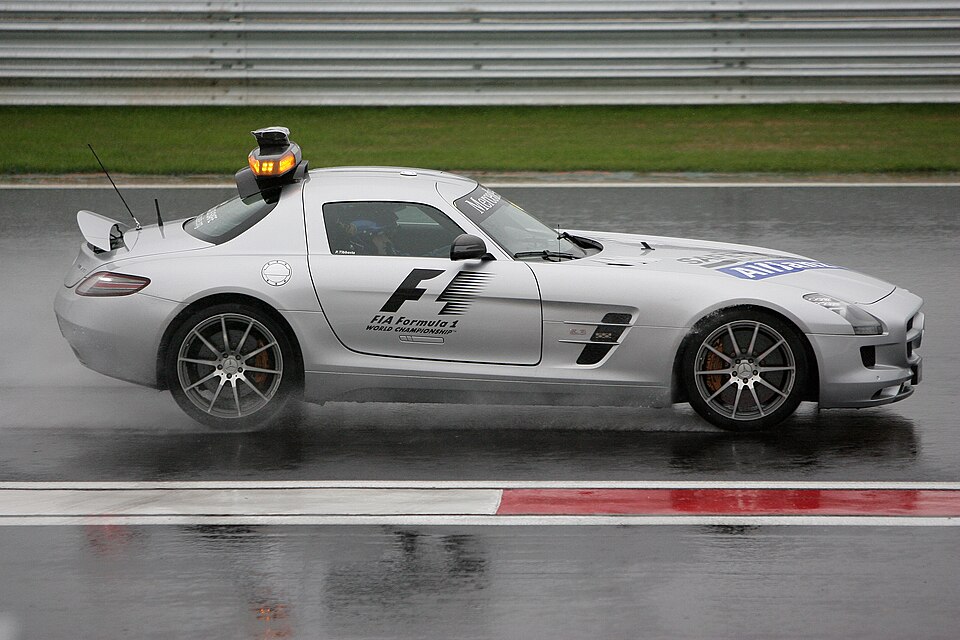
From Lamborghinis, to family sedans, Formula One’s history of safety cars was very chaotic. The modern car, leading a horde of the world’s most complex cars, was not always as regulated, and standardized.
The first safety car was deployed in the 1973 Canadian Grand Prix, when heavy rain caused multiple on track incidents. Before safety cars, marshalls used yellow or red flags to slow cars, or to stop races completely. For the first time, race organizers decided to try something different, promoting them to deploy a yellow Porsche 914 on track. Unfortunately, things did not go smoothly after this. The safety car mistakenly identified the wrong driver as the leader, pulling out in front of the wrong car, causing massive confusion. This resulted in most the the field finishing a lap down, forcing race officials to spend four hours post-race, sorting through data to eventually crown Peter Revson as the race winner. This event caused major distrust in the safety car system.
Embed from Getty ImagesThe first instance of a pace car during an Formula One Grand Prix, Porsche 914, Canadian Grand Prix, 1973
In 1976, a safety car was assigned for the Monaco Grand Prix, the second safety car assignment in Formula One history. However, due to only minor on track accidents in that race, the Porsche 911 Turbo was not officially deployed during the race.
Then, at the Monaco Grands Prix in 1981, 1982, and 1983, the streets of Monte Carlo were assigned a Lamborghini Countach, with a roof-mounted light bar and special graphics to serve as the safety car. Yet, the car was not ever deployed during a race, and instead served a more ceremonial purpose, while being on stand-by.
Almost a full decade later, in 1992, Formula One tested a safety car at the British and French Grands Prix. These tests, in a Ford Escort Cosworth, evaluated the feasibility of bunching up F1 cars during incidents to improve safety.
In 1993, the safety car became a mandated feature at all race weekends. Despite this, individual track organizers still supplied their own cars, which led to some of the most iconic safety cars, often ones that reflected the unique local car culture.
The first official debut of the regular safety car came in the 1993 Brazillian Grand Prix. Due to heavy rain and a multi-car collision on the start-finish straight, the Fiat Tempra was sent out to regulate the pack.
The Ford Escort returned in the 1993 British Grand Prix, following Luca Badoer’s crash on Lap 37.
In 1994, at the San Marino Grand Prix, JJ Lehto’s Benetton stalled on the grid, and Pedro Lamy’s Lotus slammed into the back of it at high speed. This sent shrapnel, and a wheel flying into the air, injuring eight spectators, and a police officer. Officials deployed the Opel Vectra to bunch up the field and let marshals clear the wreckage from the starting straight. The safety car circulated at a slow pace because its brakes were overheating, causing the F1 cars’ tire pressures and temperatures to drop significantly. Many fans speculate that the inefficiencies of the safety car contributed to Aryton Senna’s crash and subsequent death later in the race.
Embed from Getty ImagesThe Opel Vectra safety car leads Ayrton Senna, Michael Schumacher, Gerhard Berger, and Damon Hill, during the San Marino GP at Imola, 1994
The same year, at the Japanese Grand Prix, a Honda Prelude was used as the safety car for the race. Torrential rain caused hazardous track conditions, leading to numerous cars spinning out or crashing early on. It was initially brought out within the first few laps, then once again after Martin Brundle aquaplaned and crashed into a recovery vehicle clearing another car, breaking a marshal’s leg and resulting in a red flag and subsequent restart behind the safety car.
Then, 22 years following the first ever safety car at Canada, the Canadian Grand Prix brought an iconic safety car. At the start of the race, Mika Häkkinen attempted to overtake Johnny Herbert under braking at the hairpin. The two cars collided, suffered damage, and became stalled directly on the racing line. Track marshals struggled to quickly clear the vehicles from the dangerous area, and moments later on lap 2, David Coulthard lost control of his Williams under braking and spun out into the gravel trap. Thus, the race control decided to deploy the safety car, the now iconic Lamborghini Diablo.
The safety car, a Renault Clio was deployed at the 1996 Argentine Grand Prix because Luca Badoer’s Forti car flipped upside down into a gravel trap following a collision with Pedro Diniz. The safety car period was then extended when Diniz’s Ligier later burst into flames on the track.
Embed from Getty ImagesA Renault Clio leads the Formula One Grid of the 1996 Argentine Grand Prix
Formula 1 safety cars were standardized in 1996 when the sport partnered with Mercedes to exclusively supply high-performance official safety vehicles for every Grand Prix. Mercedes-Benz secured the exclusive contract starting mid-season, debuting with the C 36 AMG, ending the era of random local promoter cars.
The standardization of safety went beyond the cars, as Bernd Maylander took over sole duties as a safety car driver at the 2000 Australian Grand Prix. Since then, he has led the pack in several types of Mercedes cars, and Aston Martin cars when they joined Mercedes as the safety car manufacturers.
After years of experimentation and thousands of laps, the safety car has become a staple at race weekends, where it not only promotes safety, but also strategy.
All reporting and editorial content published in this article is the independent work of The Race Insider. References to Formula 1, the FIA, Pirelli, teams, drivers, and other related entities are made solely for news and commentary purposes and do not imply any partnership, sponsorship, endorsement, or affiliation. Image copyrights belong to their respective owners and are used in accordance with editorial use.
 The Race Insider
Leave a comment