In Formula One, drivers often receive most of the praise and recognition. However, behind the scenes, thousands of people work to make race weekends happen, and to ensure they run smoothly, all while being entertaining. While there are plenty of unsung hero roles within teams, this article hopes to highlight a handful of people with unique jobs that keep F1 going.
For example, there are more professional drivers hired by F1 than the 22 drivers on the grid. Bruno Correia, a Portuguese former racing driver, drives the “fastest ambulance in the world,” in addition to Karl Reindler, piloting the Medical Car. After a karting career, Correia competed in the Formula Ford 1600 championship, winning the title. Then, he raced in the Spanish Formula Renault Championship, winning the Junior title in 1995, before winning the overall championship the following year. After moving to the United States to continue racing, he soon found himself unable to secure a seat for 1998. After a hiatus, where he built a successful beach hotel in Brazil, Correia returned to racing in 2005 for a single season, where he was the runner-up in the Brazilian Super touring Championship. He then went on to work as a driver trainer for several years, before being chosen as the World Touring Championship safety car driver, the later being appointed as the safety car driver for WTCC and its support classes. In October 2021, it was announced that Correia would stand in as the Formula One medical car driver for the Turkish Grand Prix, subbing in for an ill Alan van DER Merwe.
Embed from Getty ImagesBruno Correia, Medical Car Driver
Karl Reindler, who has previously competed in the Supercars Championship, currently shares duties with Bruno Correia as the Medical Car driver for Formula One. In 2003, Reindler won Rookie of the Year in the Australian Formula 3 Championship, before winning the Championship in the following year. Reindler moved to Britain in 2005 to race in a part-season of the British Formula 3 Championship. After the 2005 season, Reindler qualified for the Macau Grand Prix, finishing 13th. In 2006 he continued with British F3, again, only completing part of the season and ultimately finishing 14th. In 2008, he joined a GTO.R team for the Daytona 24 Hour, qualifying third in GT. 8th place putright in the series awarded him the V8 Supercar Mike Kable Rookie of the Year Award. Reindler joined V8 Supercars full-time in 2010. After several more seasons of on-and-off racing, Reindler stepped in at Albert Park in 2022 as a Medical Car driver replacement for Bruno Correia, who was busy with Formula E duties.
Embed from Getty ImagesKarl Reindler of Australia, FIA medical car driver
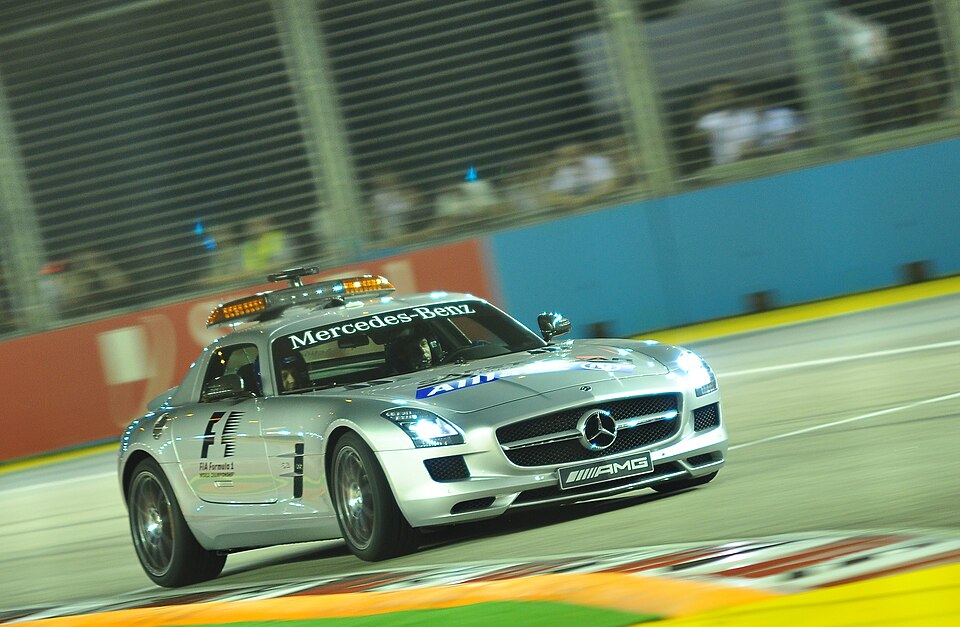
In addition to the Medical Car, the safety car is another tool to ensure driver protection during races. Starting his career in karting, Bernd Mayländer worked his way to Formula Ford, the Porsche Carrera Cup and the Deutsche Tourenwagen Masters. Racing under Mercedes in DTM from 2001 to 2004, Mayländer won one race at Hockenheimring in 2001. He first drove in Formula 3000 feeder series before stepping up to F1 in 2000, making his debut at the Australian Grand Prix. Since then, he has played a crucial role in over 500 race weekends, and led over 1,300 laps, which is more than legendary F1 drivers such as Kimi Räikkönen, Jenson Button, Graham Hill, and many more.
Embed from Getty ImagesBernd Maylander, FIA Safety Car Driver, poses for a photo with the FIA Safety Car on the grid during previews ahead of the F1 Grand Prix of Australia at Albert Park
But, for a Grand Prix to take place in the first place, drivers need a track to race on. With iconic circuits like Bahrain International Circuit, Baku City Circuit, Circuit of the Americas, Istanbul Park, Yas Marina Circuit, Red Bull Ring, Shanghai International Circuit, Sepang International Circuit and more under his belt, it clear why Hermann Tilke is renowned as a master track designer. During the 1980s, Tilke competed in touring car racing, several endurance races, including the 24 Hours Nürburgring. In 2003 and 2004, he and Dirk Adorf won a few races. In 1984, Tilke established the Tilke Engineering company, with his transportation specialized civil engineering degree. In the 1990s, Tilke got his first major job, converting the Österreichring to a shortened A1-Ring. The track was shortened, run-off zones were added for safety, and the track’s fast, sweeping corners were replaced with tight, right-handers. Now, after being purchased by Red Bull, the “Red Bull Ring” in Austria is an exciting weekend on the F1 caldender.
After viewing the track site and taking into account factors such as wind direction, soil quality, topography and local culture, Tilke begins the design process. This process, whether used to redesign tracks, or fabricate new circuits from scratch, he promises for an interesting and fast race that keeps the pack tight, providing spectator enjoyment.
However, Tilke’s track designs have been the subject of criticism. Negative reviews often accuse Tilke of using a algorithmic methods to produce boring tracks, or ruining classic circuits. Alexey Popov, a Formula One commentator used the term “Tilkedrome” to describe the formulaic designs used by Tilke. Former Formula One driver, Jackie Stewart even claimed that his designs contributed to the lack of overtaking and excitement in Formula One, describing them as “carbon copies of each other”.
Defenders of Tilke’s designs note the run-off areas around corners have brought more safety to the sport. Additionally, it is hard to argue that despite the criticism, Tilke’s tracks remain some of the most well-known tracks across the F1 season, bringing in thousands of fans.
Embed from Getty ImagesHermann Tilke at Formula One World Championship, Chinese Grand Prix, Shanghai
On the entertainment side of things, Lieven Hermans revolutionizes the F1 broadcast with the now staple helicopter shots. Hermans had been working as an aerial cameraman for several years before he started to work in Formula One. F1’s aerial camera adds complexity to F1 broadcasts, and give fans a closer, birds-eye view of the racing. This perspective helps to capture the most important moments of the race. Hermans’ F1 cameraman debut came when he was filling in for a colleague, which spiraled into him becoming the regular aerial camera operator. Although Hermans admits his role a team effort, split with the helicopter pilots, his work as an aerial videographer has made it a staple of broadcasts.
Formula One often highlights drivers firstly, then team principals, then engineers and pit crew. By the time the trickle-down attention has reached the bottom, viewers often forget to pay credit to the people who contribute to F1, making it not only entertaining, but also safe.
All reporting and editorial content published in this article is the independent work of The Race Insider. References to Formula 1, the FIA, Pirelli, teams, drivers, and other related entities are made solely for news and commentary purposes and do not imply any partnership, sponsorship, endorsement, or affiliation. Image copyrights belong to their respective owners and are used in accordance with editorial use.
 The Race Insider
Leave a comment