In F1, if something isn’t explicitly forbidden, it is allowed. As F1 is home to some of the world’s smartest engineers, teams are constantly perusing the rules, looking for loopholes to give them a performance boost. These grey areas are often regarded as some of the greatest engineering marvels in history. However, when a top team finds a technical advantage, the triumph turns into a target, or even a scandal as other teams contest its legality. In such a high-level engineering sport, breakthroughs like this often teeter between breaking the rules vs. a legal wonder.
Throughout history, several teams have tried to bend the rules to their favor, resulting in extraordinary feats of loophole-finding.
In the early 1980s, teams with naturally aspirated engines, like Tyrrell, Williams, and Brabham struggled to meet the 580 kg minimum weight limit. To counteract this, teams filled large tanks with water before the race, claiming the water was used to cool the breaks. During the race, teams would slowly drain their tanks onto the track, slowly shedding weight, and racing underweight for better performance. At the time, the governing body, FISA allowed for replenishing of cooling fluids post-race, before weigh-ins, so the water cooling teams could cover their tracks before the measurement, returning the car to a legal weight limit. FISA eventually banned the practice, due to the unfair advantage it rewarded. When Tyrrell was eventually the last naturally aspirated team on the grid in 1984, they took the concept a step further. They raced deliberately underweight without water. During late pit stops, they would add a mixture of water and heavy lead shot into the tanks to safely make the post-race weight requirement. This method was eventually discovered, resulting in the team being disqualified from the entire 1984 season.
This wasn’t the last time F1 teams got sneaky with breaks. McLaren is historically guilty of rule bending. For example, in 1997, the British team implemented a secret second break that allowed drivers to break a single rear wheel independently. By stopping or slowing one wheel, the driver was able to reduce understeer, while simultaneously generating massive mid-corner rotation. This sneaky pedal took up to half a second off of lap times, until it was discovered. The “Fiddle Break” was a tightly kept secret, up until a renowned F1 photographer detected something off. At the 1997 Austrian Grand Prix, Darren Heath noticed the rear brake discs on Mika Häkkinen’s and David Coulthard’s McLarens glowing unusually bright orange mid-corner. This led to outrage in the paddock, spearheaded by Ferrari, who demanded for the design to be outlawed. Rival teams argued the system was essentially a form of four-wheel steering, which was forbidden by regulations. In May 1998, the FIA issued a ban on any system that applied braking force to a single rear wheel for steering purposes.
Embed from Getty ImagesA view inside of the cockpit footwell from the McLaren showing the small second brake pedal on the left
McLaren did not stop poking holes in the rulebook after their rear brakes were disallowed. In the 2010 season, they introduced the F-duct system. With the use of internal plumbing systems, air would start at an air intake at the front of the car, travel through the cockpit, and be channeled to the rear wing. When the driver would cover a small tube opening with their knees or elbows, the air would be forced directly at the rear wing. This airflow would disrupt the flow of air on the underside of the rear wing, prompting a stall. This would reduce Downforce and drag, giving cars higher straight-line speed, which payed off in tracks with long straights. As the cars featured no moveable aerodynamic devices (which F1 rules strictly forbade), other than the driver, it was technically legal. Despite this, it posed some risks as drivers were forced to drive in odd positions, sometimes one-handed. At the end of the 2010 season, the F-duct was banned, but it laid the groundwork for later aerodynamic innovations, like the Drag Reduction System (DRS), which operated similarly, but with the use of electronically controlled flaps.
Embed from Getty ImagesMcLaren 2010 Formula 1 car intake valve on the front of the chasis
Before the water cooled breaks fiasco, Brabham and Tyrrell cemented themselves in F1 history as expert rule-bending innovators.
In 1976, Tyrrell released the P34, a car with 6 wheels. With a maximum front wing width of 1.5 meters, traditional tyres extended beyond the front wing, disrupting aerodynamic flow, and producing drag. Designer Derek Gardner sought a new solution. Behind the front wing, Gardner tucked two sets of smaller, 10-inch Goodyear tyres, which were shielded by the front wing. The car used four front tyres, instead of the usual two, because the smaller rubber surface area lended less grip to the car. So, twice as many tyres meant twice as much track contact. While the unconventional design was highly successful in tracks with longer straights, and sweeping corners, performance dipped on uneven courses, where the smaller tyres struggled to maintain contact. The Tyrrell P34 achieved the first and only win for a six-wheeled car in Formula 1 history at the 1976 Swedish Grand Prix, driven by Jody Scheckter in a legendary 1-2 finish with Patrick Depailler. Along with its eight second place finishes, this win helped Tyrrell secure third in the Constructors’ Championship. Unfortunately, the following year, performance began to slip. The team’s tyre manufacturer, Goodyear stopped developing the 10-inch tyres, as the hardship of investing in a tyre only one team used was proving too great. Compiled with the poor reliability and cooling of the smaller front brakes, Tyrrell stopped using the six-wheeler at the end of the 1977 season, returning to a standard 4-wheel design. Then, ahead of the 1983 season, the FIA mandated that Formula One cars must have four wheels, effectively cementing the P34 as a legendary symbol of the times. Today, five out of the seven original cars often appear at vintage racing and historic motorsport events like the Goodwood Festival of Speed, and the Historic Minardi Day in Imola.
Embed from Getty ImagesJody Scheckter drives the Tyrrell P34 to victory during the 1976 Swedish GP
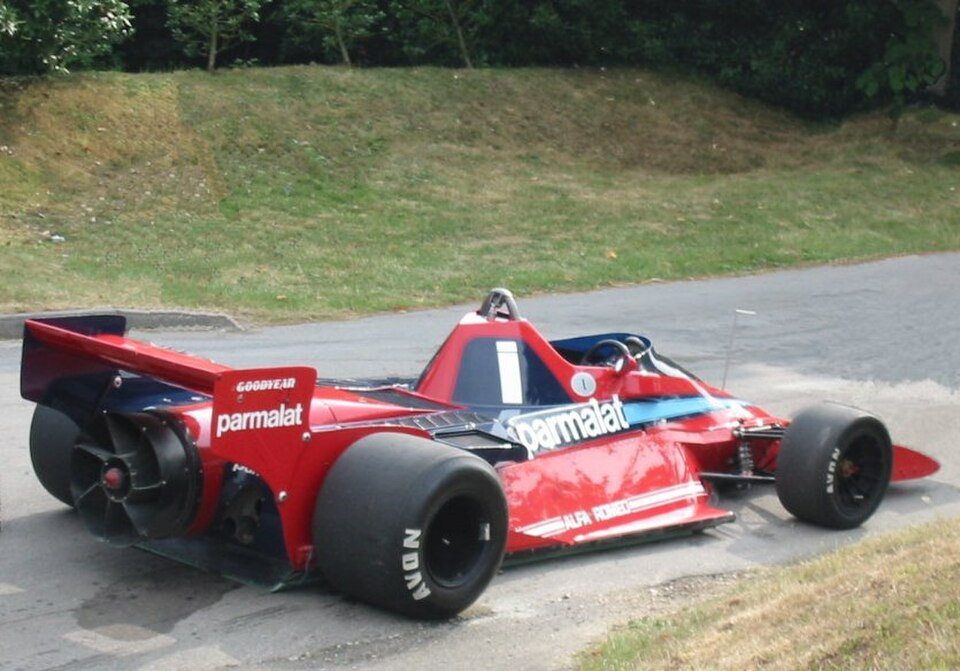
A year after the Tyrrell P34 stopped racing, Brabham tried their hand at innovating, producing the BT46B “fan car.” The famous car mounted a massive fan to the rear of the car, which, when switched on, sucked air from under the chassis, creating massive Downforce. As the ground-effect-era revolutionizing Lotus 79 was dominating, Brabham began to search for a solution. As their Alfa Romeo flat-12 engine blocked airflow, the team needed to design an entirely new concept. The car debuted at the 1978 Swedish Grand Prix, where it dominated, catapulting Niki Lauda to a 34 second gap to win. The car was so powerful, that during practice sessions, Lauda purposely under drove the car to hide its capabilities from opposing teams and the FIA. After the car’s impressive inaugural victory, rivals immediately protested the car. They complained that the fan was blowing debris into the faces of the drivers behind it, and they pointed out that the fan constituted as a moving aerodynamic device, which directly violated the rules. Brabham defended this by claiming that the fan was mainly for cooling, as it drew air through a radiator above the engine. Following the massive uproar and complaints from McLaren, Lotus, and other teams on the grid, the FIA reviewed the car. While the governing body deemed the car legal for that single race, they rewrote the rulebook to ban fan-driven suction systems for the following seasons. Faced with the threat of ongoing protests, team owner Bernie Ecclestone voluntarily withdrew the BT46B. The car retired with a 100% win rate and remains one of the most famous and radical loopholes in F1 history.
Embed from Getty ImagesNiki Lauda driving the Brabham-Alfa Romeo BT46B at the Grand Prix of Sweden, 1978
A few years later, Lotus were the ones being scrutinized. In 1981, they premiered the Lotus 88, which was composed of two nesting chassis. The inner chassis, made of advanced carbon composite, housed the driver, fuel, and engine. It used conventional soft suspension to handle curbs, bumps, and mechanical loads. The outer chassis, meanwhile, carried the bodywork, side pods, and underbody. It allowed for maximum ground effect without compromising driver comfort or safety. This solved the problem of suspension type, where softer suspensions could navigate over rough tracks, while rigid suspension keeps aerodynamics consistent. Lotus’s solution divided the two ideas into two “nesting”twin” parts. While the car passed initial inspections, rival teams protested, claiming it violated regulations against movable aerodynamic devices. The FIA ultimately banned the car, and it never competed in a single Grand Prix.
Embed from Getty ImagesElio de Angelis practicing in the controversial twin-chassis Lotus 88
Then, in the 2000s, teams began to adapt to the modern competition
For example, in late 2005, Renault implemented a secret mass, suspended in the nose cone. The 5-10 kg cylindrical weight was lodged between springs, reducing the problems of front-end bouncing, chassis vibration, and unstable downforce, which the rest of the grid struggled with. The mass damper was specially fine-tuned to each track to absorb track impacts, improving tyre contact, and keeping the front wing a consistent height above the ground. It helped to allow drivers to attack curbs aggressively without upsetting the car’s balance, while maintaining steady aerodynamic performance and grip. These elements combined took up to 0.3 seconds out of lap times, and it’s heavy use in 2005 and 2006 played a key role in securing Fernando Alonso’s championship titles. It was initially deemed legal, prompting several teams to scramble to attempt to make their own versions. However, Ferrari continued to protest it, until its eventual ban after the 2006 Hungarian Grand Prix after being ruled a moveable aerodynamic device.
In 2009, rules tried to limit rear downforce, but Brawn GP exploited a grey area, which failed to restrict bodywork vertical surfaces not directly facing the ground. Engineers left a large empty section in the center of the standard diffuser. The team then extended the flat floor of the car into this space, creating a secondary, upper-deck chamber connected by openings in the floor. This design significantly increased the volume of air flowing under the car, creating a huge area of low pressure that sucked the car to the track. At the start of the 2009 season, rival teams immediately protested the design, arguing it violated the new aerodynamic rules. Despite this, the FIA ruled that the design was entirely legal, as it complied with the rules, using ambiguities regarding the visibility of the bodywork when viewing the car from directly underneath. While Toyota and Williams also used cars with double diffusers, the Brawn chassis was itself superior. Other teams scrambled to reverse engineer their own versions of the double diffuser, a process that took months. However, the FIA officially banned the larger diffusers at the start of the 2011 season to eliminate the immense dirty Air produced by the designs.
Embed from Getty ImagesJenson Button driving his Brawn BGP 001 car with the Brawn Double Diffuser aerodynamic design visible between the rear wheels
One of the last major rule-bending innovations was Mercedes’s 2020 dual-axis steering (DAS) system. It allowed drivers to change the toe of their front tyres by pushing or pulling on the steering wheels. Pushing on the wheel would change the angle of the front tyres to point inwards at each other, generating heat and providing better grip in the corners. Inversely, pulling the steering wheel towards the driver would neutralize the toe angle, moving the wheels to an in-line formation again. This setup allowed for less drag and sliding. By using DAS, Mercedes drivers could warm up their tires on out-laps and safety car restarts, or preserve their rubber during long race stints. Unsurprisingly, the system sparked immediate controversy. Rival teams like Red Bull Racing protested DAS, arguing that it was an adjustable aerodynamic device, and an illegal suspension system. However, the FIA reviewed the design and ultimately deemed it legal for the 2020 season, before out ruling it ahead of the 2021 season.
In the current day, Formula One teams are pushing development further to adapt to the newest round of regulations. Adaptations such as the “Macarena” wing prove that more innovation is soon to come.
Formula One history has demonstrated that teams will often do all that they can to circumvent the rules for performance. The often overlooked engineers of the sport constantly push into grey-zones and ambiguity, giving fans some of the most interesting stories of secrecy, innovation and intrigue.
All reporting and editorial content published in this article is the independent work of The Race Insider. References to Formula 1, the FIA, Pirelli, teams, drivers, and other related entities are made solely for news and commentary purposes and do not imply any partnership, sponsorship, endorsement, or affiliation. Image copyrights belong to their respective owners and are used in accordance with editorial use.
 The Race Insider
Leave a comment