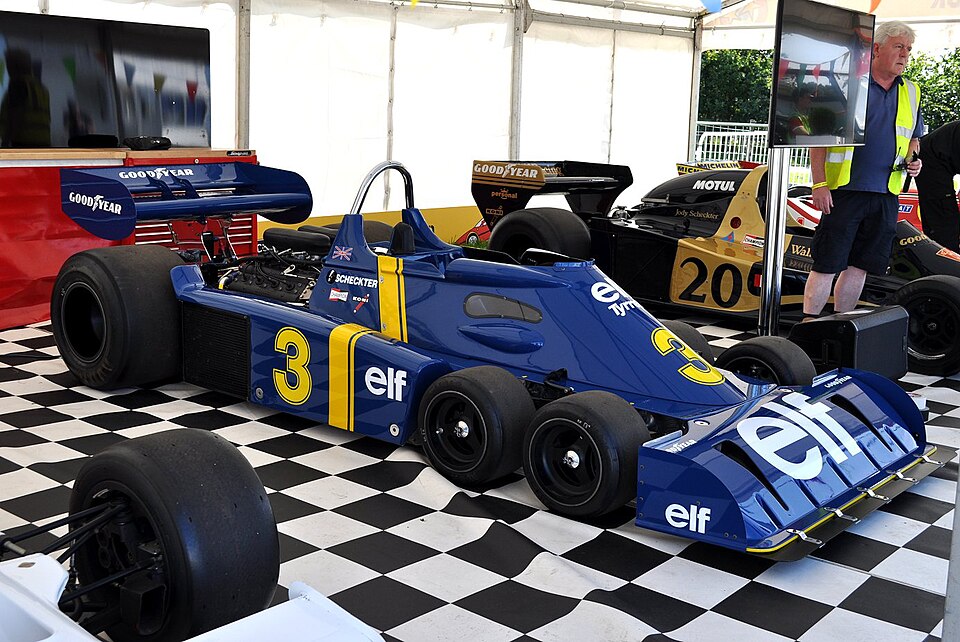
With modern F1’s strict regulations, every car looks very similar to every other. While this is beneficial for safety, it can feel monotonous at times. However, Formula 1 designs in the past were a lot more radical, and some are very memorable.
The Tyrell P34
Designer Derek Gardner realized that standard front tires created massive aerodynamic drag by disrupting airflow all the way back to the rear wing. His solution was to replace the two standard front wheels with four tiny, 10-inch wheels hidden entirely behind a wedge-shaped nose cone. By keeping the front wheels completely shielded from the oncoming air, the design aimed to achieve massive straight-line speeds while maintaining a large rubber contact patch for high cornering grip.To make the system work, Gardner engineered a highly complex, linked steering system that allowed all four front wheels to turn simultaneously. The concept worked brilliantly in practice, providing the car with incredible front-end braking stability, sharp turn-in, and drastically reduced aerodynamic resistance. The engineering triumphed on the racetrack when Jody Scheckter and Patrick Depailler secured a historic one-two finish at the 1976 Swedish Grand Prix, proving the six-wheeled concept was a legitimate contender. Despite the early success, the car’s ultimate downfall came from a lack of development support rather than a flaw in the engineering concept. Goodyear, the sole tire supplier for the grid, refused to spend its research budget upgrading the specialized 10-inch front tires while simultaneously fighting a fierce tire war with standard sizes. As standard rear tires rapidly evolved, and other competing tyre manufacturers entered the paddock, the small front tires were left behind, causing severe handling imbalances and overheating issues that forced Tyrrell to abandon the design by the end of 1977.
Embed from Getty Images Embed from Getty Images Embed from Getty Images Embed from Getty ImagesThe Brabham BT46B
During the 1978 season, Brabham designer Gordon Murray needed a radical solution to counter the dominant wing-cars by the Lotus team. Traditional ground effect designs required deep, sculpted air channels under the car, but Brabham’s wide Alfa Romeo flat-12 engine physically blocked this path. Looking at past experimental sports cars, Murray decided that if he could not use traditional airflow to create a low-pressure zone under the car, he would use active suction to force one instead. Murray installed a massive, prominent fan at the very rear of the car and sealed the sides of the chassis to the asphalt using flexible rubber skirts. To bypass strict regulations banning “movable aerodynamic devices,” he cleverly connected the fan to the engine gearbox and routed it through a radiator, claiming its sole legal purpose was engine cooling. In reality, the fan acted like a massive vacuum cleaner, sucking air from beneath the sealed floor to pin the car to the track with immense downforce, even when navigating slow-speed corners.The car debuted at the 1978 Swedish Grand Prix and proved to be completely unstoppable, with Niki Lauda easily cruising to victory. However, the extreme design immediately sparked outrage as rival drivers claimed the rear fan launched dangerous stones and track debris directly into their faces. Sensing an impending dispute, Brabham owner Bernie Ecclestone voluntarily withdrew the car after just one race to protect his rising position in F1 management, and the FIA swiftly banned the concept.
Embed from Getty Images Embed from Getty Images Embed from Getty Images Embed from Getty ImagesLotus 88
By 1981, the first generation of ground-effect F1 cars had rock-hard side skirts that scraped along the track to seal the underfloor airflow. To maintain this crucial aerodynamic seal, teams had to make their suspensions incredibly stiff, meaning the massive downforce pushed the entire car down and subjected drivers to a violent, bone-shaking ride. Legendary designer Colin Chapman sought to solve this physical toll on drivers by engineering a car that featured two completely separate chassis nested inside one another. The inner chassis housed the driver’s cockpit, the fuel tank, and the engine, and it was mounted on soft, conventional springs to give the driver a comfortable ride. The outer chassis consisted of the entire aerodynamic bodywork, including the wings and sidepods, and was pinned to the hubs by its own hyper-stiff suspension. When the car accelerated, the immense air pressure pushed solely down on the outer chassis, sealing it to the track while the driver inside remained completely cushioned from the crushing physical loads.The revolutionary design looked set to transform the sport, but rival teams immediately protested its legality before it could ever properly compete. They argued that because the entire aerodynamic body shifted independently from the inner driver cell, the outer chassis constituted a massive movable aerodynamic device. The governing body agreed with the rivals and banned the twin-chassis Lotus 88 before the start of its first race, leaving its true on-track potential forever unknown.
Embed from Getty Images Embed from Getty Images Embed from Getty ImagesMarch 711
Aerodynamicist Frank Costin approached the 1971 season with a goal to create a racing car that enjoyed completely clean, undisturbed airflow over its main body. During this era, most teams bolted low, flat front wings directly across the nose of the car, which shoved air abruptly upward and created massive turbulence over the driver and engine cover. Costin believed he could generate the necessary front downforce without ruining the efficiency of the rest of the car’s bodywork.To achieve this, Costin shaped the main nose cone of the March 711 like a smooth, rounded surfboard that could slide through the air with minimal disruption. He then mounted a highly distinctive, elliptical front wing high above the nose on a single, central vertical strut, earning it the immediate nickname of the “tea tray” or “surfboard” wing. This elevated placement allowed the front wing to work in clean, undisturbed air while the air passing underneath traveled smoothly over the cockpit straight to the rear wing. While the car looked incredibly strange, it possessed surprising pace, and a young Ronnie Peterson miraculously drove it to five second-place finishes to secure runner-up in the world championship. However, the radical high-wing design suffered from inherent structural weaknesses, as the single mounting strut was prone to severe, unpredictable vibrations at high speed. The complex aerodynamic balance also made the car highly sensitive to crosswinds and turbulent air from traffic, prompting March to move toward more conventional wing placements.
Embed from Getty Images Embed from Getty Images Embed from Getty ImagesWhile a lot of these designs were unsafe, and unreliable, the strangeness and innovation that came with the cars made the revolution exciting. These visual changes brought a sense of novelty back to the sport, and add to the richness of Formula 1 history.
 The Race Insider
Leave a comment